The Invisible Hand: Why the Producer Is the Most Underrated Artist in Music
Put on Thriller. Let it run for about thirty seconds. Now ask yourself: what made that record feel like nothing that came before it? Was it Michael Jackson's voice? Sure. His performance? Absolutely. But the reason that album sounds the way it sounds — that dense, cinematic, perfectly pressurized thing — is Quincy Jones. And yet, how many people who own that record on vinyl, on CD, on a streaming playlist they've had since 2014, could tell you Quincy's name without hesitating?
That gap — between how much producers contribute and how little credit they receive — is one of the most persistent blind spots in music culture. And it's worth talking about.
What a Producer Actually Does
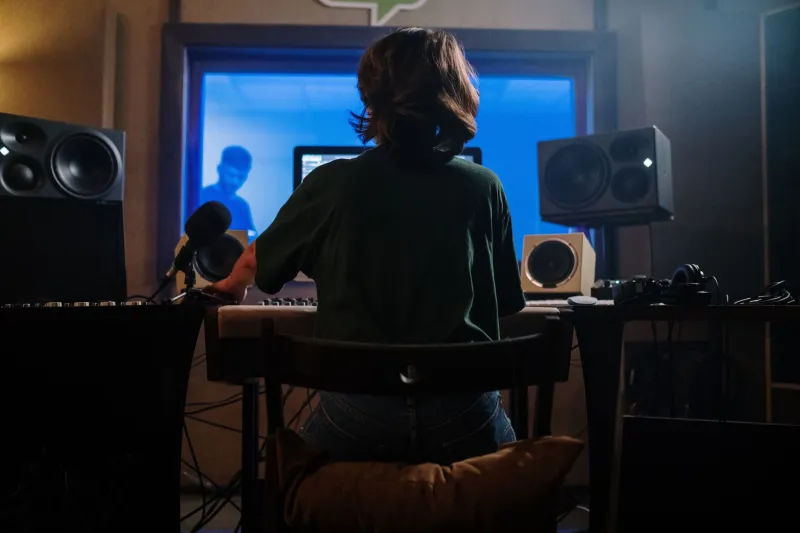
The confusion starts with the title. "Producer" in music doesn't mean what it means in film, where a producer is basically the money and the logistics. In the studio, a producer is something closer to a co-author. They choose the sonic palette. They push the artist toward better takes. They decide when a song is done, what it needs, what it doesn't. They are, in many cases, the reason a record sounds the way it does.
Some producers work from behind a mixing board, shaping what's already been recorded. Others build the entire instrumental from scratch and hand it to an artist to finish. Some do both. Rick Rubin is famous for stripping things down — removing layers, clearing space, letting the song breathe. Max Martin is famous for the opposite: constructing these airtight pop machines where every element is deliberate and nothing is wasted. Neither approach is more legitimate than the other. Both are unmistakably artistic.
The point is: production is not a technical service. It is a creative act. And the people doing it are making decisions that shape the cultural impact of the music we remember.
The Names You Know (and the Ones You Don't)
Some producers have broken through into public consciousness. Dr. Dre. Pharrell. Jack Antonoff has gotten more mainstream recognition in the last few years than most producers see in a career, partly because the artists he works with — Taylor Swift, Lana Del Rey, Lorde — are so vocal about the collaboration. That visibility matters. It teaches listeners that the sound they love didn't just materialize out of thin air.
But for every Antonoff, there are dozens of producers who shaped albums you've loved for years and whose names you've never once searched. Take Butch Vig, who produced Nirvana's Nevermind — arguably one of the ten most culturally significant American albums ever made. Ask a random person on the street to name someone involved in that record and you'll hear Kurt Cobain, Dave Grohl, maybe Krist Novoselic. Butch Vig? Crickets. And yet the decision to record that album the way it was recorded — that particular combination of raw energy and radio-ready polish — was as much his call as anyone's.
Or go further back. Norman Whitfield produced a string of Temptations records in the late '60s and early '70s that essentially invented psychedelic soul. He was pulling the genre in a darker, more experimental direction when Motown was still mostly focused on clean, bright pop. Those records sound the way they sound because of choices he made. But when people talk about the Temptations, they talk about the harmonies. They talk about the choreography. Whitfield's name barely comes up.
The Beatmaker Problem
In hip-hop, the dynamic gets even more complicated. The producer creates the beat — the entire musical foundation of the song — and in some cases, the rapper gets top billing while the producer is listed in the liner notes, if that. There are exceptions. DJ Premier, Pete Rock, J Dilla — heads know those names. But mainstream audiences often don't.
Metro Boomin has done more than almost anyone in recent years to change this. He turned his tag — that "Metro Boomin want some more, ni**a" drop — into a brand identifier, making it impossible to hear his beats without knowing who made them. It was a savvy move, and it worked. But it also shouldn't have been necessary. The credit should come with the contribution.
The streaming era has made this worse in some ways and better in others. Spotify now lists producers on track credits, which is a genuine improvement. But the algorithm still surfaces artist names, not producer names, when it's building you a playlist or recommending what to listen to next. The infrastructure of how we discover music is still built around performers, not the people building the rooms those performances happen in.
Why Recognition Matters
This isn't just an industry fairness argument, though it is that too. It's a cultural argument. When we don't acknowledge producers, we get an incomplete picture of how music actually gets made. We teach new listeners — and new artists — that the voice is the work, when the reality is that recorded music is a collaborative construction.
There's also a pipeline issue. If young producers don't see people who do what they do being celebrated, the incentive structure gets distorted. The goal becomes getting an artist to blow up so you can ride the wave, rather than building a body of work you can be proud to put your name on. Recognition shapes ambition. It shapes what people think is possible.
And honestly? The stories are fascinating. The behind-the-scenes history of almost any iconic album is full of creative tension, unexpected decisions, and moments of genuine genius that happened in the control room, not in front of the microphone. Brian Eno's ambient experiments that bled into U2's sound. Timbaland's rhythmic approach that made late-'90s R&B feel like it was coming from another planet. These are rich, compelling stories. We're just not telling them enough.
Start Listening Differently
The easiest thing you can do right now is look up who produced the last album you loved. Not the artist. The producer. Read about them. See what else they've made. Follow that thread.
You'll almost certainly end up somewhere unexpected — some other record you hadn't connected to the one you started with, some pattern in the sound that suddenly makes sense. That's what happens when you start hearing production as its own language.
The ghost in the mix has been there all along. It's time to start calling them by name.